Start here: the basics
MCP vs APIs: what is the difference?
Most MCP servers sit on top of an API. The API stays the same, and the server describes it in a way an AI agent can use without a developer writing each request.
An API is a list of requests a service accepts. GitHub's API takes GET /repos/acme/web/issues and returns that repository's issues. A developer reads the docs, picks the request, and writes it into the program.
An AI model can't work that way. It decides what to do in the middle of a conversation, and nobody wrote the request for it ahead of time. An MCP server fills that gap by describing what the API can do as tools the model can look up and call.
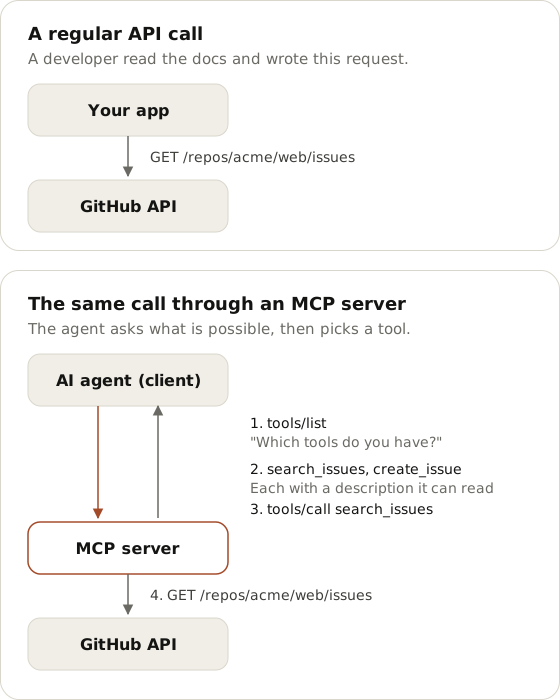 The same request reaches the same API either way. With MCP, the agent finds the tool and decides to use it.
What the server adds
The agent starts by asking the server what it has, with a request called tools/list. Back comes a list of tools, each with a name, a sentence on what it does, and the inputs it takes. For example: search_issues, "Search issues in a repository by text and status."
To use one, the agent sends tools/call with the tool's name and inputs. Every tool is called that way, whatever it does underneath.
The server then turns that call into the real API request and returns the result. GitHub never knows an AI was involved.
Side by side
| API | MCP server | |
|---|---|---|
| Who uses it | Code a developer wrote | An AI agent, through an AI app |
| How you find out what it can do | Read the documentation | Ask the server with tools/list |
| How actions are described | Endpoints and parameters in docs | Tool names and descriptions a model reads |
| How it is called | A different request for each action | tools/call with the tool name and inputs |
| How access works | API keys or OAuth, set up by the developer | The same keys or OAuth, held by the server or the app |
| Example | GET /repos/acme/web/issues | search_issues with "checkout" and "open" |
Look at the access row. The server reaches the API with a key, so it can do whatever that key can do. If the key can merge pull requests, any agent that can call the server's merge tool can merge too. This is why teams decide tool by tool what each agent gets, which MCP permissions goes into.
MCP client vs MCP server
The client is the part of the AI app (Claude Code, Cursor, ChatGPT) that connects to a server and calls its tools when the model decides to. The server is the program offering the tools.
An app connects to as many servers as you add, with one client for each. A server doesn't care which app is calling, as long as it speaks MCP. What is an MCP server? follows one request from start to finish.
Turning an API into an MCP server
Since the server is mostly a description of the API, you can often generate one. Many APIs publish an OpenAPI spec, a file listing every request the API accepts, and a generator can turn each request into a tool.
Statio's mcp-gen does this, and How to turn an OpenAPI spec into an MCP server walks through it. To write one by hand, start with the Python or TypeScript tutorial. Check the catalog first, though. The API you want may already have a server.